Showing posts with label denkmal. Show all posts

Saturday, November 29, 2014

Platz der Vereinten Nationen (Leninplatz)


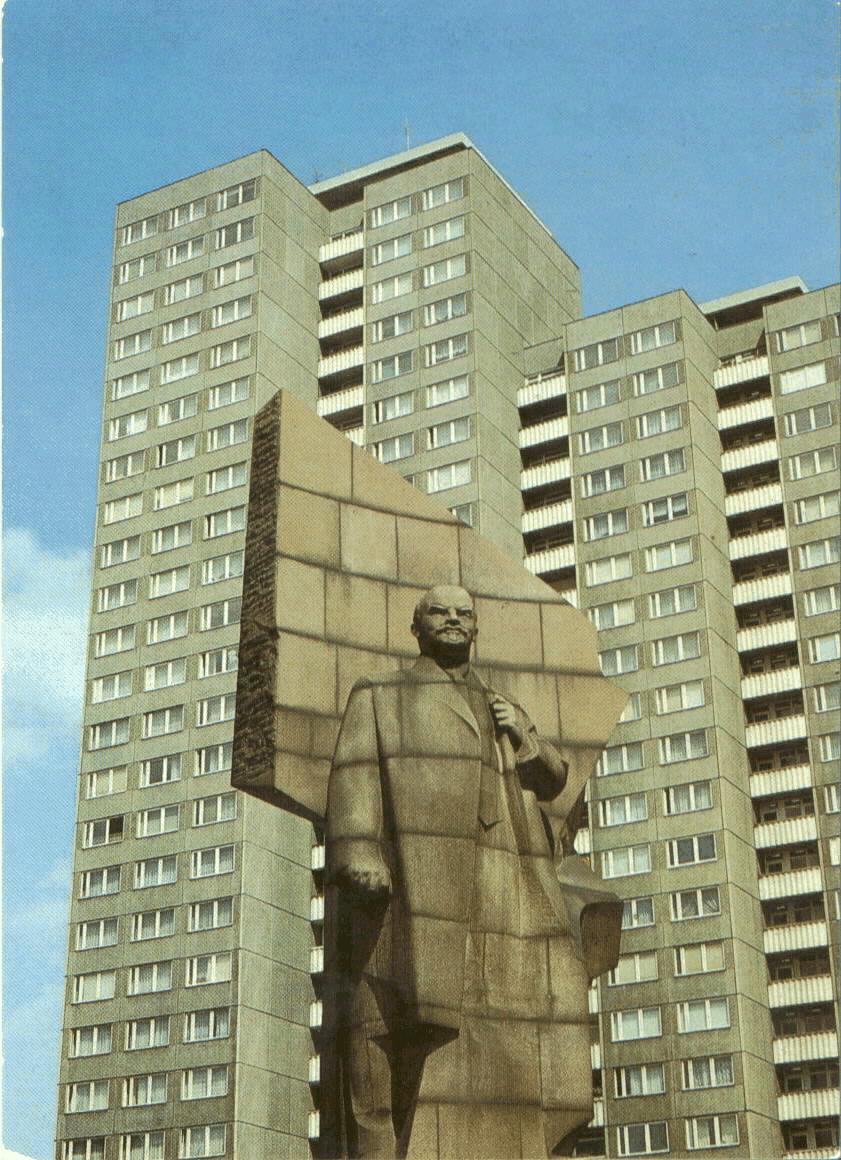
Today this square (united nations square) looks very simple and quite and without a strong meaning, but before it was Leninplatz.

In the beginning here was standing the Landsberger Tor, then, after the end of the WWII this area was heavely destroyed (with the rubbish they built the 2 mountains of the Volkspark Friedrichshain just behind the square).
On the occasion of the 100th anniversary of Lenin in 1970, a completely new urban district with a newly designed Lenin Square.
The square is one of the outstanding examples of the socialist urban DDR (with one of the tallest residential buildings in East Berlin) and symbolizes the transition of the city with the old buildings on the lower Landsberger Allee with the Friedrichshain Hospital into a modern city center around Alexanderplatz.

The 19-meter high statue of Lenin stood on a circular base, 26 meters in diameter. The monument was made of red, Ukrainian granite.

In 1991 the statue has been removed, the demolition of the entire monument took several months until February 1992. Many people tried to stop the demolition or block at least, so that the work took longer than planned.
The 129 parts of the monument have been buried in the sand pit at Seddinberg at Müggelheim.

More infos: WIKI (german)

All images are under CC Creative Commons (Attribution, Noncommercial, No Derivative Works), please refer to " darioj laganà | www.norte.it "


Monday, June 2, 2014

The Pink Tube - Umlauftank (Tiergarten)

Have you ever noticed this huge pink tube at the border of Charlottenburg on the small island between Tiergarten and the Berlin Zoo?
The "Rosa Röhre" was designed by Berlin architect Ludwig Leo the UT2 was completed in 1974. This striking pink loop has a length of 120 meters and holds a water volume of 3300 tons. The UT2 is thus the largest circulation and cavitation tank in the world and it's now an historical building under Denkmalschutz. The building was originally built for routine testing in shipbuilding. It is no longer commercially operated for a long time and used exclusively for research projects of the University (the Institute of Land and Sea Transport uses the circulation tank regularly for propulsion and cavitation trials with which the overall design of hull and propeller is investigated). 
UT2 is considerably damaged, especially in the outer shell, but there are some possibilities that it will be restoreted soon and used for research purposes by TU Berlin.

More infos: WIKI (german)
Map: http://goo.gl/maps/bs5DZ

All images are under CC Creative Commons (Attribution, Noncommercial, No Derivative Works), please refer to " darioj laganà | www.norte.it ".


Thursday, May 29, 2014

Maps: Jews & Shoah


Berlin has a long tradition with the Jewish community and unfortunately their story is also related with the tragedy of the Holocaust. Now in Berlin lives the biggest Jewish community of all Germany.
This is a new map of the city to help you to descover the old and the new places regarding it.
On the top-west part of the map there's one point which is not Berlin, but a place you need to visit, the KZ Sachsenhausen - Concentration camp (Oranienburg).

Full map: http://goo.gl/maps/meYMy


Blindenwerkstatt Otto Weidt
Denkmal für die ermordeten Juden Europas
Example of "Stolpersteine"
Foundation New Synagogue Berlin - Centrum Judaicum
Gleis 17 Memorial
Jüdische Mädchenschule
Jüdischer Friedhof Charlottenburg
Kindertransport (statue)
KZ Columbia Memorial
Memorial to Homosexuals Persecuted Under Nazism
Rosenstraße protest
Rykestrasse Synagogue
U-Bahn Wittenbergplatz
Zentrale Orthodoxe Synagoge zu Berlin

Monday, March 10, 2014

Inside the Borsigturm, the first skyscraper in Berlin (Tegel)

We've already talked one year ago about the Borsig Locomotives, which was in 1872 the largest locomotives' company in Europe, and in addition to the Baldwin Locomotive Works in the United States, the world's second largest locomotive supplier.
Among the other buildings in Tegel, there's the Borsigturm, built in 1922-24 and considered the first skyscraper in Berlin.
Conrad and Ernst von Borsig gave at the Berlin architecture professor Eugen Schmohl (that a little later designed the Ullsteinhaus in Tempelhof) the contract for the design of an office building, which was for the first time extend beyond the permitted height for industrial buildings of 5 floors.
The 65 m tower served initially as a water tower, by installing a water tank on the ninth floor, but then it was used as an office building, a symbol of the Borsigwerke. In the 1970s and 1990s it was renovated and reused as an office building. The interior was not accessible to visitors until 2009.
But now we've been able to get inside the tower (the 10th floor is for rent by Meistersaal im Borsigturm GmbH) and to take these pictures of the inside and of the view of the Tegel's area.


More infos: WIKI (german)


All images are under CC Creative Commons (Attribution, Noncommercial, No Derivative Works), please refer to " darioj laganà | www.norte.it "